
Eight years ago this month, I did a blog post on this site that I ended with this line: “I am already looking forward to the next 17 years.” That was August 2018. And the blog entry was titled When do I exit stock positions.
That 17-year reference wasn’t mine. Warren Buffett mentioned it in his Sun Valley 1999 speech because 1964–81 (when Dow stayed flat) and 1981–98 (when Dow went up ten-fold) happened to be of the same duration, and I borrowed it because it sounded better than “a while”. Anyhow, now that we are eight years into it, let’s see how far we’ve come:
Stocks have done very well since then. The S&P 500 has returned 14.8% total return annualized. That’s about 3x multiple in eight years. My own portfolio has done even better as I reported in January. All in all, it has been very rewarding eight years of investing.
So where does this lead to? Do we think the remaining nine years will be as productive? I don’t know and I am not good at predicting market behavior. However, there is good amount of optimism and resulting high valuations in today’s stock market. One could almost believe that we are nearing similar market sentiment as Buffett encountered in 1999 when he gave that Sun Valley speech.
My old post asked: sell or hold? But there is a third answer that I wanted to elaborate on this post. More on it further down.
Eight years ago, I told you Buffett held his stocks because his favorite holding period is forever. But there was a nuance to it. It only applied to what he considered wonderful businesses, not just all of them. It turns out that while he kept his favorite businesses, he did sell some as the Y2K bear market approached.
He wrote this is the 1999 shareholder letter:
Right now, the prices of the fine businesses we already own are just not that attractive. In other words, we feel much better about the businesses than their stocks. That’s why we haven’t added to our present holdings. Nevertheless, we haven’t yet scaled back our portfolio in a major way.
At the time, Berkshire’s equity portfolio (from 1998 annual report) looked like this:
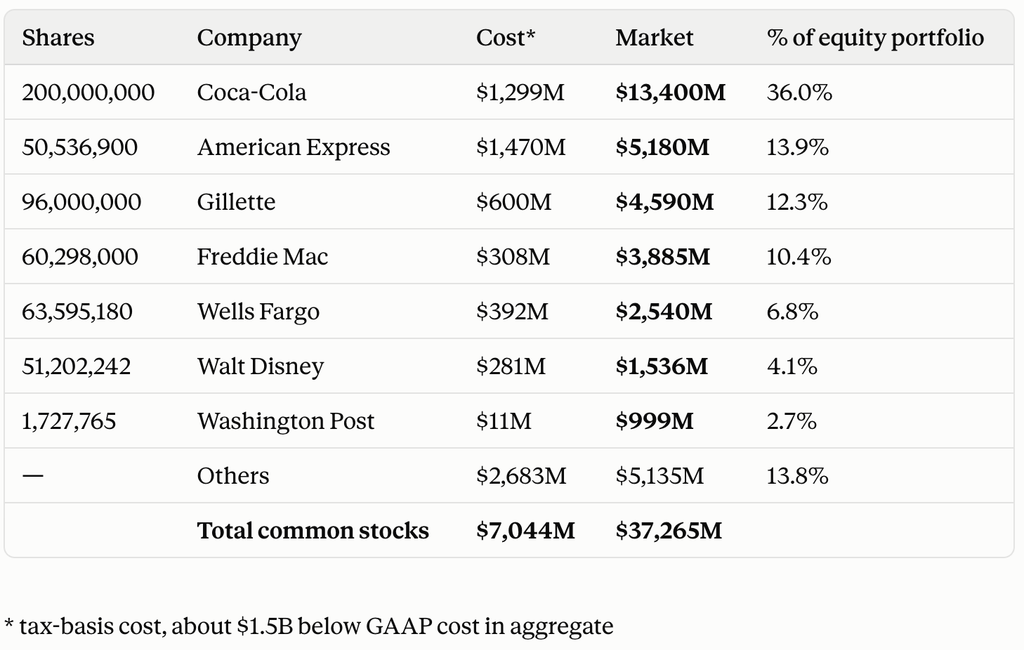
The concentration was extreme even by his own standards. Coke alone was 36% of the equity book. The top three were 62%. And note the embedded gains.
Berkshire pays full corporate rate on gains — no preferential capital gains treatment. At year-end 1998, exiting Coke and AXP would have triggered roughly $4.5 billion in tax at 35%. You’d need the stocks to fall 35% just to break even on the round trip.
So Buffett chose not to sell, though with some exceptions. In 1998 he sold McDonald’s, which he flagged in the same letter as a mistake. Then in 2000 he sold nearly all of the Freddie Mac and the Fannie Mae shares.
Freddie Mac was a 10% position carried at 12x cost — every tax argument against selling Coke applied equally to it, and he sold anyway. He kept the consumer franchise and exited the leveraged financial. Both were expensive in 1999; only one had a balance sheet that could kill it.
So the honest version of the 1999 story isn’t that “Buffett never sells on valuation.” It’s that he separated expensive from fragile, and only acted on the second.
What did he do from 1998 through the 2000-02 bear market? First, he bought General Re in 1998 by issuing new Berkshire Class A shares when they were at record premium to book. Then he asked Gen Re to dispose of all the public equities it held – roughly 250 common stock positions.
And then he redeployed its vast cash inflow everywhere but public equities: Such as whole businesses, distressed debt, foreign bonds and stocks, and even short currency positions.
So how did he do relative to the stock market in those 17 years that he predicted were going to be lean years. He did quite well, considering the period’s average returns:
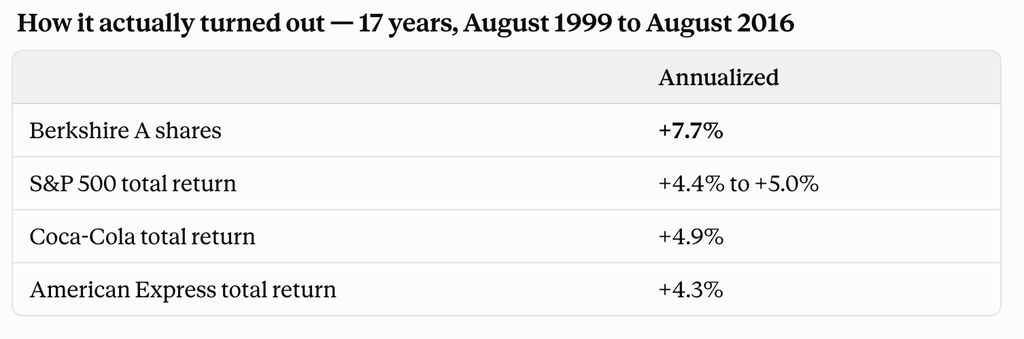
Coke and American Express weren’t the disasters that many other high-flying Y2K era stocks were. Berkshire beat the market by 3 points a year. And the outperformance came almost entirely from where the new money went – the bond pivot, the operating company purchases, the 2002 junk bond window, PetroChina, and the cash hoard that funded the 2008–09 Goldman, GE, and Swiss Re deals — not from what he sold.
He was bearish with his marginal dollar and agnostic with his legacy dollar.
So this is the setup for the burning question of the day:
Given how well stocks have performed in last eight years, should we, individual investors with long-term mindset, become bearish like Buffett was in 1999?
Buffett himself hasn’t said anything directly that could be considered an answer. He did say this in a CNBC interview at this year’s annual Berkshire meeting:
We’ve never had people in a more gambling mood than now.
His actions (and inactions) suggest that he is being careful with deploying new cash in public equities today. With Berkshire keeping a record cash pile and fourteen consecutive quarters of net equity selling (broken only once in 2Q26 with Alphabet private placement at a discount to market).
As Howard Marks said in one of his memos:
“We never know where we’re going. But we sure as hell oughta know where we are.”
Given how rewarding previous eight years have been (a patient market indexer has tripled his capital since then), one ought to become cautious about the next nine years. How can I, an individual investor, do that?
Third Option? Going back to the question I posed eight years ago: sell or hold? The answer today is still the same:
(1) Continue to hold wonderful businesses that I own.
(2) Only sell those that I no longer think are durable or well managed.
At the same time, a third option also becomes clear:
(3) Redirect my incremental dollars elsewhere.
This is one transferable lesson I take away from Buffett’s post 1999 speech saga. It is in essence my current investing focus. I will be holding on to all my favorite stock positions, as I’ve explained frequently in these pages. I have on occasions liquidated some positions that I have lost my trust in – like PayPal I reported in June (liquidated entirely as of this month). But my new capital is not going into buying more stocks. Not with the market where it is today.
So where are my dollars going? Mostly to my cash hoard. And where am I getting these new dollars from? Because unlike Mr. Buffett, I don’t own any operating businesses that produce cash flows. And how am I investing cash to get some return on it. I’ll attempt to answer these questions in my next blog post.
Final words: My seventeen-year framework is arbitrary. It started when I wrote that post, not when some market cycle turned. But Howard Marks’s line still applies: I don’t know where we’re going. I’d just like to know where we are — and August 2018 is as good a place as any to measure from.
Leave a Reply