
Let’s begin by stating the obvious: SpaceX is a remarkable company that transformed space exploration into a new commercial industry, driven in large part by Elon Musk’s vision and leadership. After a long wait since its founding in 2002, SpaceX is finally becoming available to the public. Even so, I plan to stay on the sidelines for this one. Here are my three reasons behind skipping the IPO.
A One-of-a-Kind Business
SpaceX started with a bold and risky bet by Elon Musk. As a16z put it in a recent blog post, SpaceX & the Sentient Sun:
He said SpaceX would put humans in orbit when no private company ever had; today, it flies NASA’s astronauts routinely. He said it would land and reuse an orbital rocket when the industry treated boosters as disposable; SpaceX has since done it hundreds of times. He said a satellite internet business could be worth tens of billions when satellite internet was a graveyard of bankruptcies; Starlink’s revenue has climbed from zero to $11.4 billion in a few years. His predictions were often aggressive on timing but almost never wrong on direction.
(1) The “IPO” Stands for “It’s Probably Overpriced”
First, I avoid investing in IPOs. There is a reason Ken Fisher called them “It’s Probably Overpriced” in his book The Wall Street Waltz. IPOs are always accompanied by wide market recognition and high expectations, which is why dour markets don’t see many of them. Today, the market is feeling very optimistic, and there is a lot of hype with new and upcoming IPOs.
I’ve always steered clear of IPOs, keeping my distance even when the companies going public were exceptional. My own portfolio history reflects this discipline; I often buy into great companies, but well after their initial IPO hype is over. For instance, Amazon went public in May 1997, but I waited almost three years to initiate my position in March 2000. Meta held its IPO in May 2012, and I waited until June 2013 to buy my first shares. Even with Tesla, which has since become a core holding, I didn’t buy in until April 2014—nearly four years after it went public in June 2010.
When you invest with the intention of holding shares for decades, waiting patiently for the right entry price becomes second nature.
Take a look at my portfolio. Out of my top twenty positions, there are only three that I bought within the first five years of their IPOs. I tend to be an opportunistic buyer, not an IPO buyer. Almost all my positions were initiated either during a market-wide dislocation (e.g. GFC crisis for Berkshire, Costco, Markel; COVID crash for Blackstone) or right after a company-specific stumble (Meta’s failed IPO, Starbucks management crisis, Tesla pre-scale uncertainty).
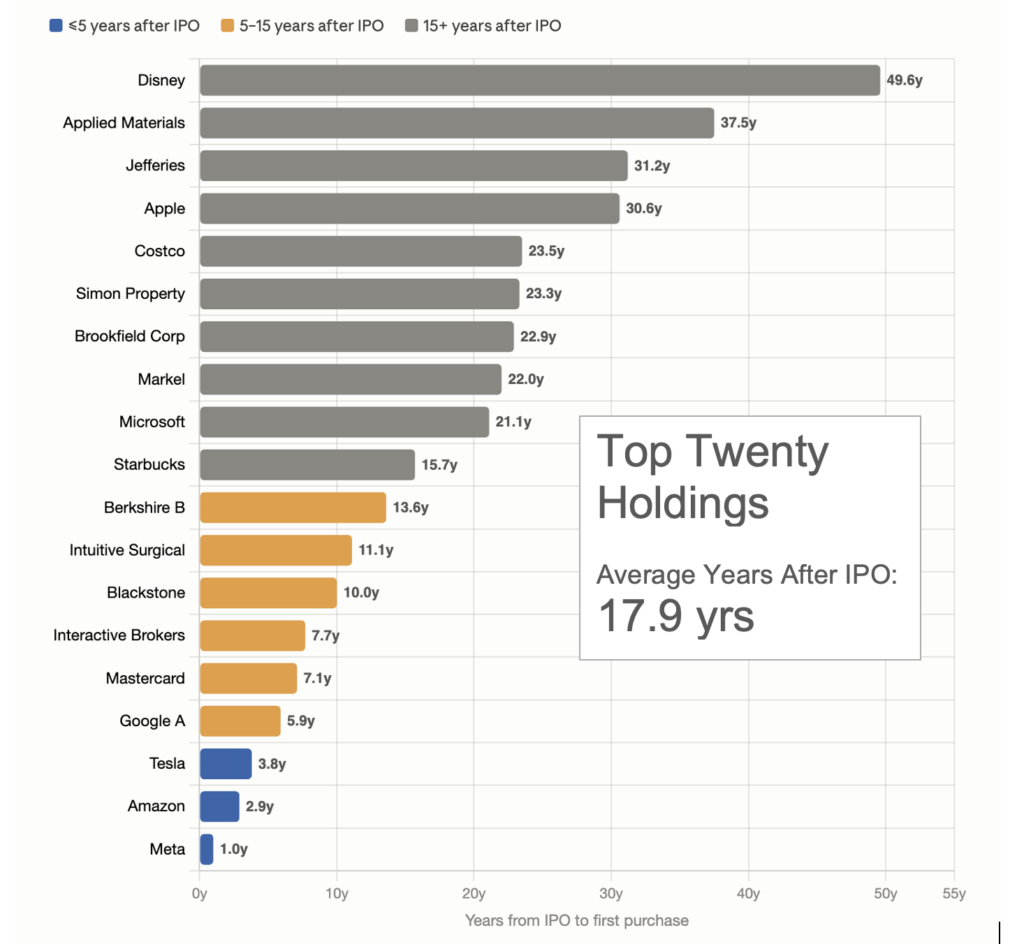
I don’t know if SpaceX will go through a significant downturn anytime soon. But if it happens, I may take another look at it; for now, I pass.
(2) SpaceX and Tesla Share a Common Future
Secondly, I own a substantial stake in Tesla. It first became a top ten position in 2020 and has been among my top five holdings since 2021.
SpaceX and Tesla are tied at the hip. For one thing, they are both run by Elon Musk, who has done wonders with both companies. Both sparked new industries that were not there before: reusable spacecraft and electric vehicles. Under Musk, SpaceX and Tesla have been closely collaborating on several key projects, all tied to eventual SpaceX success:
- Tesla designs and produces AI chips that SpaceX requires for deployment in space-borne datacenters.
- Tesla is building Optimus robots and training them with its physical AI expertise. These are needed by SpaceX for building factories on other planets.
- Tesla will be manufacturing solar panels that SpaceX needs for electricity generation.
- SpaceX and Tesla have a joint collaboration project to manufacture silicon chips on a large scale called Terafab – an industrial initiative that launched with an event in Austin in March.
It is quite likely that SpaceX’s success in achieving its ambitious AI-in-space goals will be accompanied by a huge boost in Tesla’s business too. There is also some talk about SpaceX and Tesla eventually getting combined into a single public corporation. I don’t know if it will happen but being a Tesla shareholder keeps me in a good position to benefit from SpaceX’s future success.
(3) High Valuation and a Tesla Lesson
Finally, I first opened a Tesla position in 2014 when its market cap was about $25 billion. It had just entered mass production of its first commercial product, the Model S sedan. It was a great car (I own one since 2014), but too expensive for mass-market appeal. There were lingering doubts whether it could produce a cheaper EV, ramp production fast enough, and survive an economic downturn since auto manufacturing is a very macro sensitive sector.
A Tesla Lesson
When I profiled Tesla in a March 2020 post, it hadn’t yet transitioned from a niche product meant for early adopters to a mainstream product for the majority market. Over the following years, as Tesla successfully made this transition, the market rewarded it with a much higher market cap, making my holding go from the #8 to the #2 position today.
Now compare Tesla’s situation in 2014 with today’s SpaceX. Unlike Tesla, SpaceX is already well recognized for its proven space launch prowess and satellite communications tech. There are no doubts about the viability of its products and services. It’s valued today as a $2.4 trillion business. For SpaceX to give me even a 3x return from here, it would need to reach $7.2 trillion valuation. I’d be buying a monopoly at a steep premium, not an early-stage disruptor like Tesla was in 2014. No, thanks!
Final words:
SpaceX is a strong enterprise rewriting the rules of aerospace and global communications. However, a good company does not automatically equate to a smart stock purchase if the entry price demands perfection. By avoiding the inherent overpricing of IPOs, relying on the strategic overlap between SpaceX and my existing holdings in Tesla, and maintaining discipline regarding high valuations, the decision becomes straightforward. While I will watch their continued progress, I am keeping my capital deployed elsewhere for now.
Postscript:
SpaceX (SPCX) started trading on June 12th. So far, it had a euphoric first week, a blow-off top and then a reversion toward the IPO price as early traders exit. Today, it is trading at about 16% up from its IPO price. The market cap is $2 trillion.
Since my last post in May, the market has largely treaded water, with the S&P 500 dipping 2.5% so far this month. As you might expect, there wasn’t much activity in my portfolio. I did take some profits on Applied Materials (AMAT) at a new high and cut my PayPal (PYPL) holding in half, with plans to liquidate it entirely. Meanwhile, I picked up some more Microsoft (MSFT) and Blackstone (BX) shares—both market-neutral additions at their current undervalued prices.
Leave a Reply