I bought my first Apple (AAPL) shares on July 11, 2011. Six weeks later, Steve Jobs stepped down as CEO. So, as it turns out, my entire Apple holding has really been a Tim Cook holding. In April this year, Apple announced that Cook would step down. John Ternus took over as CEO on September 1st and Cook stays on as executive chairman. It’s perhaps a good time to go back through my Apple investing notes and see how my thinking has held up over the years.
About my investing journal:
For every stock I own, I keep a running journal where I jot down my thoughts. It might be about a blowout quarter, a big product launch, a management change, a shift in capital allocation, or a price drop that tempts me to add. The entries are short and informal. My Apple journal has about 30 dated entries. The first is from January 26, 2012, when I was weighing a third helping after my first buys in mid-2011. The last is from March 19, 2025, when Apple delayed its Siri and AI features. The busiest stretches were 2015 and 2018, when the stock was falling and I was considering buying more. About a dozen entries record a purchase and why I made it. In recent years the entries get sparse, roughly one or two a year. Partly that’s because the thesis was working and needed less defending, which, looking back, is itself a lesson.
Apple is up about 27x from my first purchase. Counting every add, trim and dividend along the way, my money-weighted return is about 28% a year. Back in 2018, I wrote in CEOs take pay cuts that I was “happy to ride along with him.” Judging by the stock performance, it has indeed been a beautiful 15-year ride with Mr. Cook.
What I was thinking in 2012
My early notes read like a growth story. In January 2012 I was considering a third helping after buys in July and August 2011. The iPhone 4S “sold like hot cakes.” Apple couldn’t make enough of them for China. The iPad and Mac were riding a halo effect. And yet the stock traded at 12.7x trailing earnings with $98 billion in cash. (I told the story of those early buys, and what I paid, in this 2018 post Apple, Starbucks, Facebook, Tesla.)
At the time, I also wrote down my doubts. Three of them, word for word:
- “Can Tim Cook sustain innovativeness of Jobs?”
- “Do we really think AAPL could be the first 1 trillion company??”
- “Don’t people get bored when everybody has the same phone?”
I’ll come back to each of these near the end of the post.
2013: The next Microsoft?
By early 2013 the stock had fallen 44% from its September 2012 peak. Margins were slipping, and everyone was calling Apple the next Microsoft (Microsoft had a bad rep back then.) My note from February 2013 agreed, sort of:
“AAPL may be slowing down now – similar to MSFT slowing down post 2000. BUT AAPL valuation is what MSFT is now and not where MSFT was in 2000 (P/E=75).”
Apple was trading at about 10x earnings. A slowdown was already in the price. I laid out three scenarios (optimistic, base, and bad) and gave myself one simple rule: keep holding unless the bad scenario emerges. By bad I meant losing market share, a string of failed products, or no longer being considered cool. I bought twice that quarter.
That rule turned out to be the backbone of my whole holding period. In hindsight, my base case was too rosy. I assumed about 15% growth. Revenue actually grew about 8% a year from FY2013 to FY2025. It didn’t matter. Buybacks and a much higher multiple did the heavy lifting. Sometimes you can be wrong on the details and still right on the decision.
Cook earns my trust
September 2014 was my turning point on Cook. The bigger iPhone 6, Apple Pay and the Watch all came in one event. On Apple Pay I wrote that it was “doing what Google Wallet could not do,” with Visa, Mastercard, Amex, the big card issuers and the big merchant chains all signed on. My note that day:
“The company has proven to me that it still has the same mojo as in Jobs’ days.”
I also wrote that the new products probably wouldn’t “move rev/earnings needle much in the beginning – but that’s ok.” That’s how the Watch and AirPods played out: slow at first, then a wearables business as big as the Mac.
What convinced me that this company is in good hands was the CEO’s actions on his own pay. When Cook became CEO in 2011, he was given a one-time grant of 1 million restricted stock units (RSUs) worth about $385 million at the time. It was meant to cover ten years. In 2014, with the stock down sharply, Cook asked the board to retroactively make his 2011 grant contingent on Apple’s total shareholder return (TSR) versus the S&P 500. He also volunteered to give up dividends on any unvested shares. With that change, he could have lost up to 50% of his award if Apple stock underperformed.
That year’s proxy put it plainly: He “faces only downside risk from the modification.” I covered more details of this voluntary pay cut in a 2018 post. Few CEOs have done anything like it, before or since.
How did it play out:
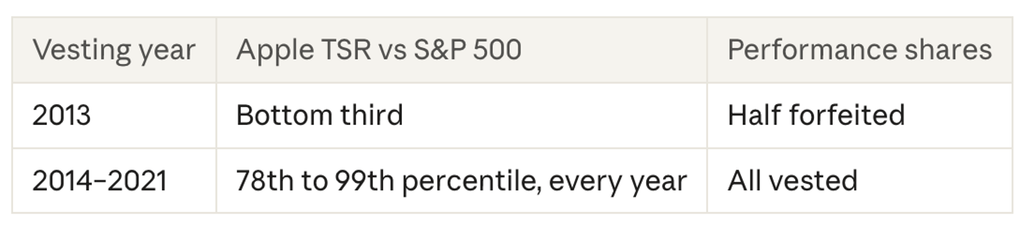
2013 was the only performance miss but it cost him shares worth about $69 million at today’s price. Past that, Apple consistently performed in the top third for eight years running.
I prefer founder-led companies (here’s why). Apple under Cook was an exception, and this was the reason.
The cash machine, and buying the dips
By 2016 the growth story had stalled. iPhone sales fell about 20% that year. But Apple had become something else: a cash machine. Free cash flow ran above net income. About 30% of the market cap was net cash. Then management set a goal of getting to “net cash neutral,” which meant returning excess cash to shareholders. In late 2018 I worked out that buybacks and dividends would return about 10% of my purchase price every year for the next four years. In my 2018 post grading CEOs as capital allocators, Apple was one of my two “outstanding share repurchasers.” The share count has since dropped by almost half. Berkshire Hathaway too jumped on the Apple bandwagon in 2016. The more the merrier!
In September 2014, after Apple’s promising launch event featuring iPhone 6, Apple Pay, and Apple Watch, I wrote: “Clearly ecosystem is becoming more sticky for consumers – Apple moat is widening IMO.” I also admitted Apple was “not my biggest stake by any means.” I hadn’t bought in eight months, and my whole position was still a modest one. That day I added a small helping at $100. Looking back, the stickiness call was the right one. My own notes kept recording the evidence. In 2015 about 30% of new iPhone buyers were Android switchers. By 2019 wearables were as big as the Mac. And paid subscriptions grew from about 300 million in 2018 to 745 million by 2021. The moat I could only sense in 2014 became its Services business, second only to the iPhone. My stake grew with it. I kept adding through the 2015–16 and 2018 dips, and by 2018 Apple was one of my largest positions. From that $100 purchase (about $25 after the 2020 split), the stock is up roughly 14x.
Over those 15 years, my trading pattern was simple: add when it’s down, never sell into a decline, and trim only near highs.
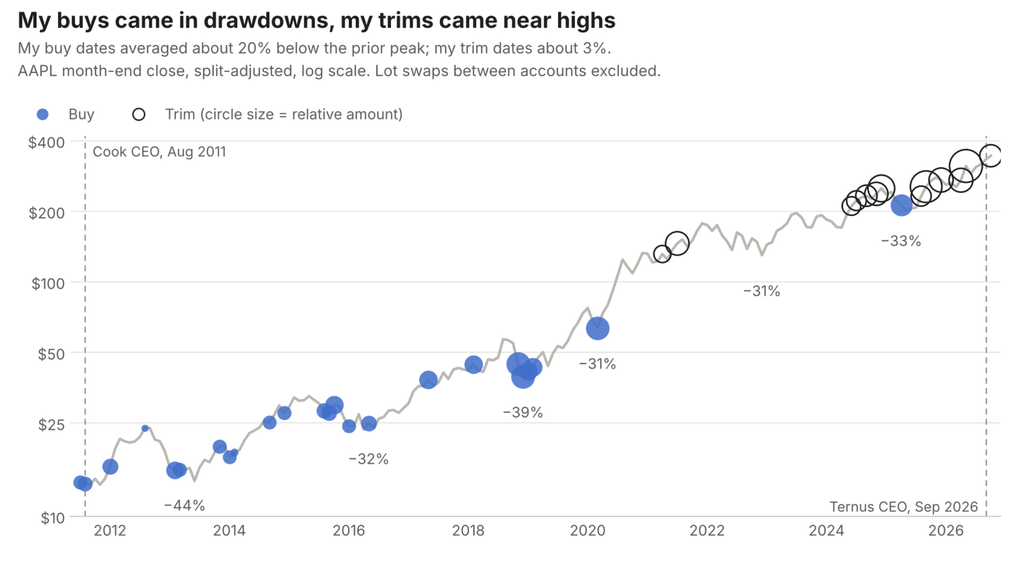
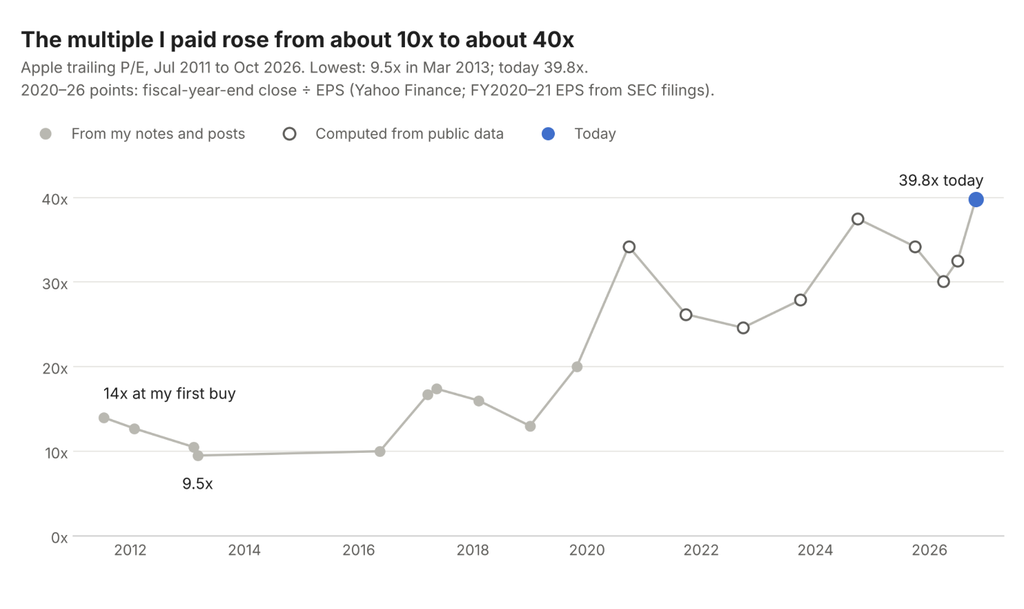
Apple fell 30% or more six times since I owned it. I bought in five of them and sold in none. Since 2021 I’ve been trimming, mostly into strength. That isn’t a change of heart. It’s position sizing, and a multiple that went from about 10x to 40x. In My Magnificent Six stocks, I explained why I trim winners without selling them. I still hold most of my shares. Apple rose to become my top-three portfolio position in 2017. Since then, it has consistently stayed there even with my episodic trims.
No crazy acquisitions
In March 2017 I noted in my journal, “I really like that Cook does not do crazy acquisitions like some others – only bolt-ons so far.” That held up for his whole tenure. His one big deal was Beats ($3 billion in 2014), which gave us Apple Music. Nearly everything else was a small tuck-in: AuthenTec became Touch ID, PrimeSense became Face ID, and Intel’s modem unit became Apple’s own modem chip. In most years Apple spent less on acquisitions than it spent on buybacks in a single week. A few bets fizzled with the car and VR projects but no deal ever came close to hurting shareholders.
Grading Tim Cook
The numbers first.
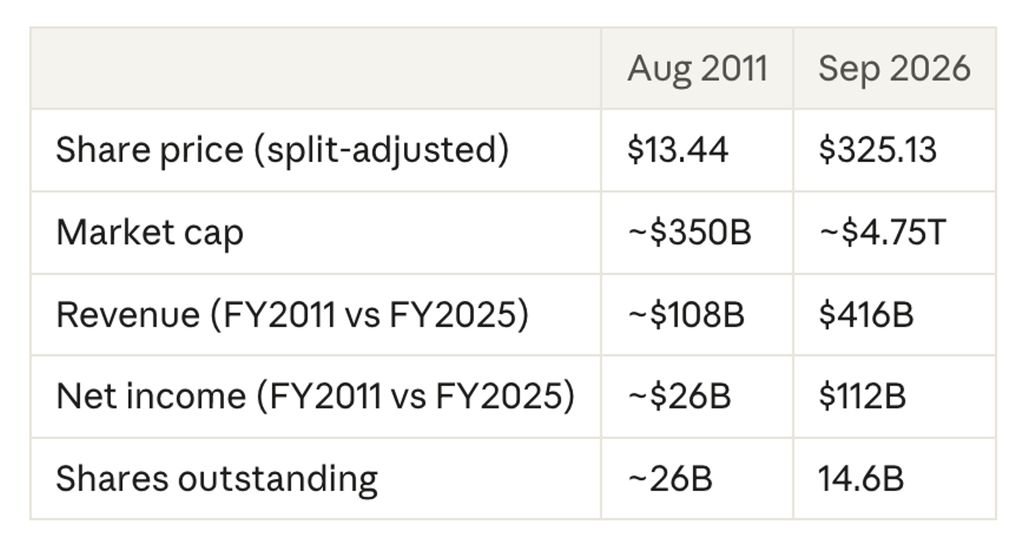
That’s about 24x on the stock, or about 23.6% IRR before dividends.
What did it cost shareholders? Cook’s pay over those 15 years adds up to about $880 million. That’s roughly 0.02% of the value created on his watch. His 2011 grant was valued at $376 million when it was granted, and it was worth about $1.68 billion by the time it fully vested. It grew because the stock did. From 2012 to 2020, he got no new stock at all, just salary and bonus of about $10 million a year.
My 2012 questions, answered
- Could Cook sustain Jobs’ innovation? Partly yes. Even though no new iPhone like product but iPhone itself has become a powerhouse and indispensable ecosystem. See more on this below.
- Could Apple be the first $1 trillion company? It did, in 2018. It’s worth about $5 trillion today.
- Don’t people get bored when everybody has the same phone? The opposite happened. Ubiquity became the network effect: the more people carried an iPhone, the more useful each one became.
One line from my notes reads differently now. In August 2015 I wrote that Apple “has never gotten expensive anyways.” That was true for years. At about 40x today, it isn’t. That’s one reason I trim.
Still a happy rider
I’ve written before about how I think about leadership changes. Ternus has been at Apple since 2001 and ran hardware engineering. An insider handoff like that is usually the kind I like. Though I wish the company would go back to once-a-decade kind of CEO incentive pay it used before. [Starting in 2022 after Cook’s 2012 package was completed, the board decided to switch to yearly stock awards.] I’m keeping my core Apple shares, and expect the company to continue to excel.
When I first bought Apple in 2011, the iPhone was a great phone. Today it’s the one device we never leave home without: wallet, keys, camera and health tracker in one. With about 2.5 billion active Apple devices, the iPhone is a distribution powerhouse. Android may run more phones, but it’s split among dozens of makers, and Google owns only the software. Apple owns the whole stack, from the chips to the App Store, and it has customers who spend the most. The iPhone has become a toll road, and only Apple collects the tolls.
Apple was never one of my emerging-to-entrenched finds. It was already entrenched when I bought it. Sometimes buying quality at a fair price is enough. So far so good. I’m still a happy rider, just with a slightly lighter load.
Leave a Reply