
Given how stocks have outperformed most other asset types in last few years (the S&P 500 is up 27% and 95% since the beginning of 2025 and 2023 respectively), it’s perhaps appropriate to remind ourselves of inevitable drawdowns that come sooner or later. In July 2020, I wrote in a blog post (A guide for young investors):
The first thing to recognize is that your portfolio will go down in value sooner or later. If you will be investing over a period of ten years or longer, it’s almost a certainty that you will see major price declines. This is table stakes in this investing game.
The uncomfortable truth is this: The very stocks that create the most wealth in any given decade also put their shareholders through brutal declines — both during that winning decade and in the decade right before it. Below, I’ll share with you some evidence of this from three different studies:
(1) No Great Decade Without Pain:
Hendrik Bessembinder in his paper, Extreme Stock Market Performers Part I: Expect Some Drawdowns, looked at the 100 most successful firms in each of the seven decades since 1950 in U.S. market history (measured by shareholder wealth created) and found that even within their best decade, these stocks suffered an average drawdown of 32.5%, lasting about 10 months. And in the decade just before? The average drawdown was a stomach-churning 51.6%, lasting nearly two years.
The individual cases were wild. Netflix landed on the 2010s wealth-creation list despite an 80% collapse from mid-2011 to late 2012 — inside its winning decade. Bank of America (BAC) created $221 billion in the 2010s while its shareholders absorbed a 69% drawdown in that same decade, on the heels of a 92% wipeout during the financial crisis. Citigroup (C) made the 2010s list too, right after a 97% prior-decade drawdown — about as close to zero as you can get and still recover. Cisco (CSCO), one of the 2010s winners, had fallen 86% in the dot-com bust; Nvidia (NVDA), before becoming a 2010s wealth machine, dropped 87% in 2002 alone. Even boring old Oracle (ORCL) posted a 77% drawdown in 1990 during the very decade it created $214 billion.
(2) The Price of 500x:
The pattern holds even for the rarest of winners. Worldly Partners, Generational Investing: The Discipline Behind 100+x Outcomes, studied 334 U.S. companies that returned 100x or more since 1972 — a cohort that averaged an astonishing 533x, compounding at roughly 17% for forty years. The lived experience of owning them? An average drawdown of 65% along the way, with 82% of these companies falling more than 50% at some point, and an average of eight years between new highs. Oracle (ORCL) owners bounced between 50% and 83% underwater for roughly eight years starting in 2001. Axon (AXON), a 32% compounder since its 2001 IPO, spent nearly a decade — about 40% of its trading life — down 50-90%. Walmart (WMT) went twelve years without a new high even as the business kept growing, and Costco (COST), Starbucks (SBUX), and Meta (META) all endured multi-year stretches down 40-60% on their way to generational returns.
(3) Even Perfect Foresight Hurts:
And if you think skill lets you sidestep the pain, consider Wesley Gray’s “Even God Would Get Fired as an Active Investor” thought experiment. He built a hypothetical portfolio with perfect five-year foresight — literally knowing the winners in advance. He took the top 500 U.S. stocks, calculated each one’s forward 5-year returns, bought the top decile for his simulated portfolio, rebalance and repeat from 1927 to 2016. That impossible portfolio compounded at 29% a year… and still suffered repeated gut punches: Down 40% in the dot-com bust (August 2000 to September 2001, with recovery taking three years) and down 41% in the financial crisis (May 2008 to February 2009). As Gray showed in his paper, even an all-knowing telepathic fund manager whose portfolio handily beat the S&P 500 index would have suffered huge volatility on occasions (worst drawdown -76%) and as a result he would have been fired many times over.
One blunt lesson from these three studies: Drawdowns aren’t a bug in long-term compounding — they’re the toll booth. If the best stocks of every decade, the 500-baggers, and even a clairvoyant investor couldn’t avoid them, neither will we. The edge isn’t in dodging the declines; it’s in holding through them.
26 Years of Drawdowns:
I ran the numbers on my own top 10 holdings — the biggest peak-to-trough drop each stock suffered after I bought it, how long the fall was, and how long it took to climb back. These are my winners, mind you. The keepers. And here’s what the data says:
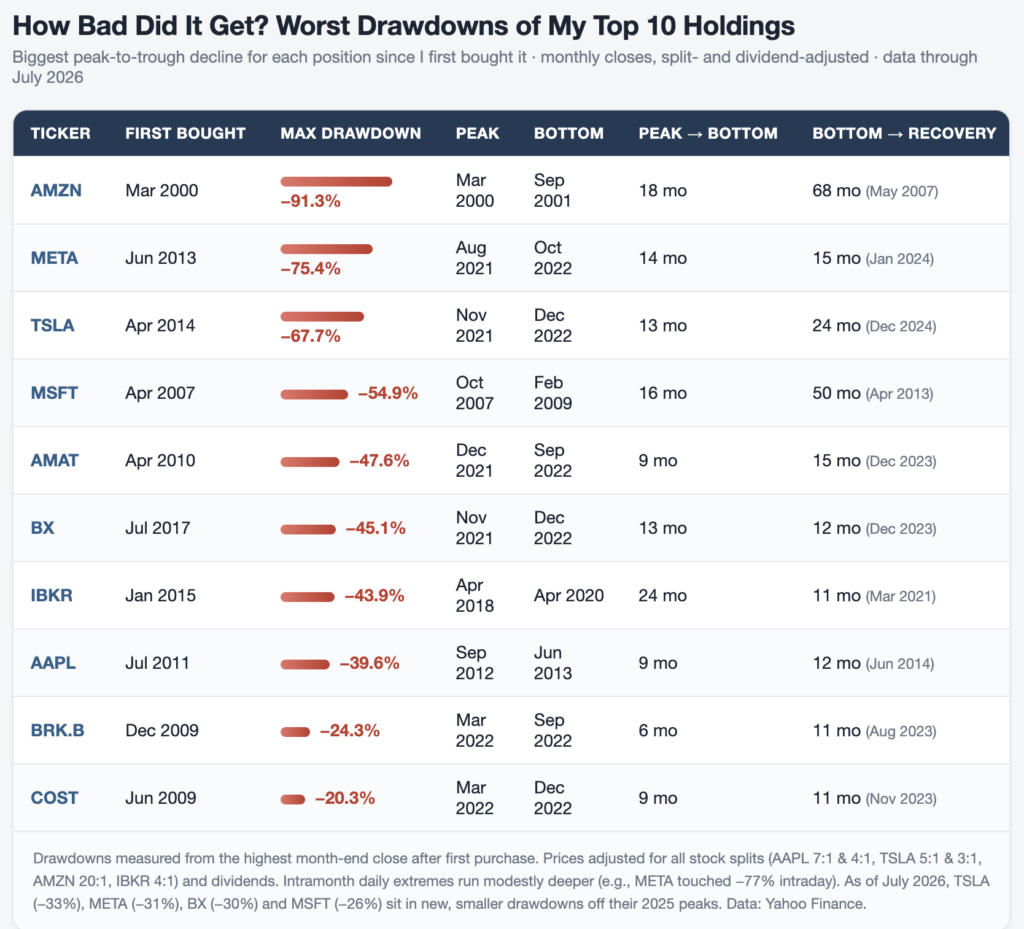
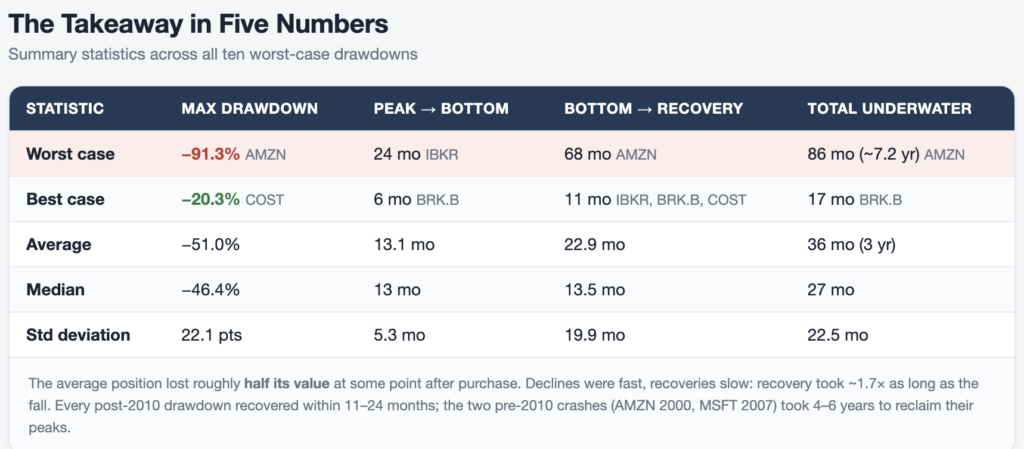
The average worst drawdown across my ten best positions was −51%. Not the losers I sold — these are the stocks that made me big money. Half of them lost 45% or more at some point while I owned them. Amazon fell 91%. Meta fell 75%. Tesla fell 68%. If you can’t stomach watching a position get cut in half, you can’t hold the stocks that eventually 10x.
If you own individual stocks, plan on this: at some point, your best ideas will fall about 50%, the drop will take roughly a year, and getting back to even will take one to three years — maybe seven if you bought into a bubble. Nothing in my top 10 avoided this. My excellent long-term return (19% 10-year IRR) came from not selling when in the middle of a drawdown. Check my portfolio’s returns here.
Even if you only invest in broad market indexes rather than individual stocks, the lesson still holds: Drawdowns don’t destroy wealth. Reacting to them does. Stay even keel when you have time on your side.
One honest caveat: there is survivorship bias in this data. These are my top performing positions, not my losers The lesson here isn’t that “everything eventually recovers.” It’s that “even the things that DO work could hurt this much along the way”.
July Market Note: The US stock market barely budged in July. The S&P500 slipped 0.13%. Yet, there was significant volatility underneath, with some sectors like semiconductor and hardware underperforming quite a bit. I stayed put in my portfolio – neither bought nor sold any stock in July. As of the end of the month, my portfolio is off from its peak by about 5%, a level not enticing enough for me to do any buying. I’m content with seeing the market churn as it often does.
Leave a Reply