I have been reading The Motley Fool’s investments letters since 2002, especially its flagship product, Motley Fool Stock Advisor. In those early years, brothers David and Tom Gardner would each personally pitch one stock recommendation every month. I appreciated David Gardner’s investing wisdom. For those unfamiliar with the Fool history, David co-founded The Motley Fool with his brother, Tom. What started in 1993 as a free educational service on AOL eventually branched out in a few different directions before settling into a paid subscription service after the Dot-Com crash.
Both brothers are talented writers. They co-wrote their first book, The Motley Fool Investment Guide, back in 1996. I credit them heavily for teaching me a foundational lesson early on: how to treat stocks as actual businesses rather than just flashing ticker symbols. Those were my formative years as an investor, and I was mostly a passive indexer. Even though I rarely bought stocks they’d recommended at the time, I thoroughly enjoyed reading their business analyses each month. The newsletters would arrive by mail, usually only a quick read of four to six pages. I still have some of those paper mailings circa 2002. See this:
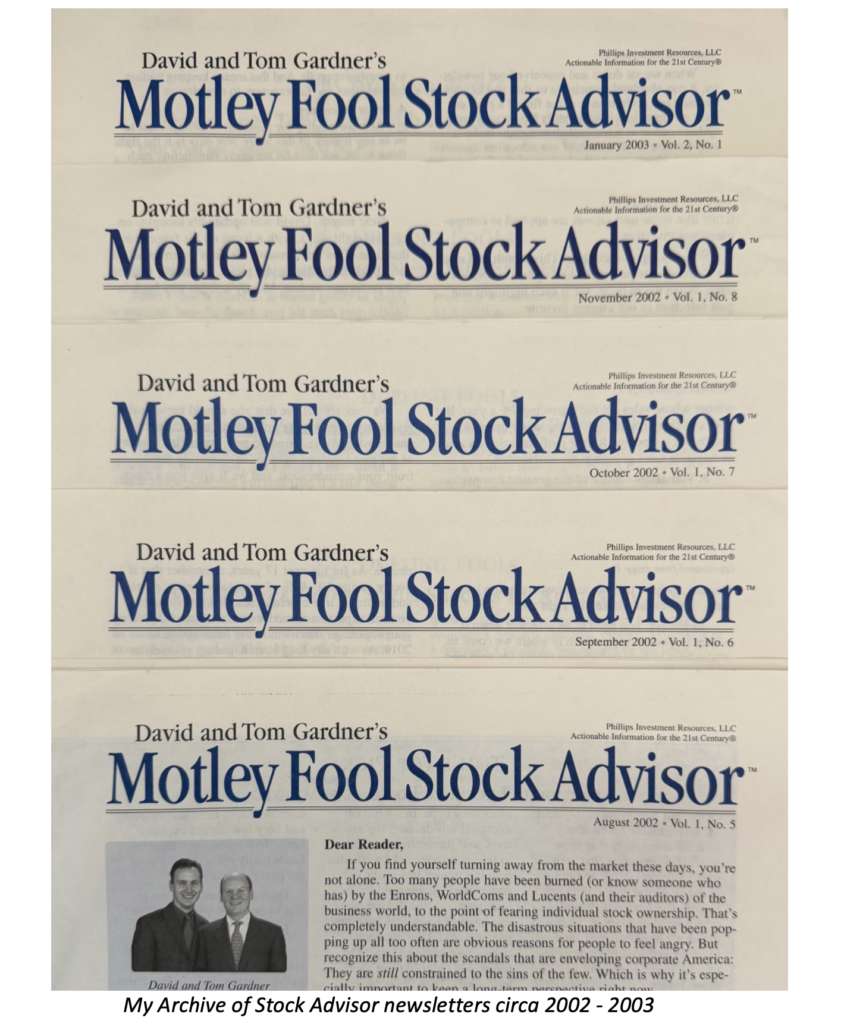
As I mentioned, I wasn’t actively picking individual stocks then, but the space fascinated me. I give credit to the Fool for keeping my interest alive in Amazon (AMZN), a stock I’d originally bought on my own in 2000. Stock Advisor had first recommended Amazon as a buy back in 1996. It re-recommended it several times after Y2K. See this copy of the October 2002 issue where David re-rec’d Amazon:

Stock Advisor also introduced me to Activision (ATVI), a business I wasn’t familiar with at the time. See September 2002 newsletter below where David Gardner first recommended it, and I eventually ended up buying it for my own portfolio years later in 2010.

Since 2002, the Stock Advisor service has handily beaten the broader market. As of early 2026, it has returned about 900% versus the S&P 500’s 185%. That massive outperformance came down to holding onto a few generational compounders for decades. They were early to recommend foundational tech giants like Amazon, Netflix, and Nvidia, simply letting the math of infinite upside run its course over multiple market cycles.
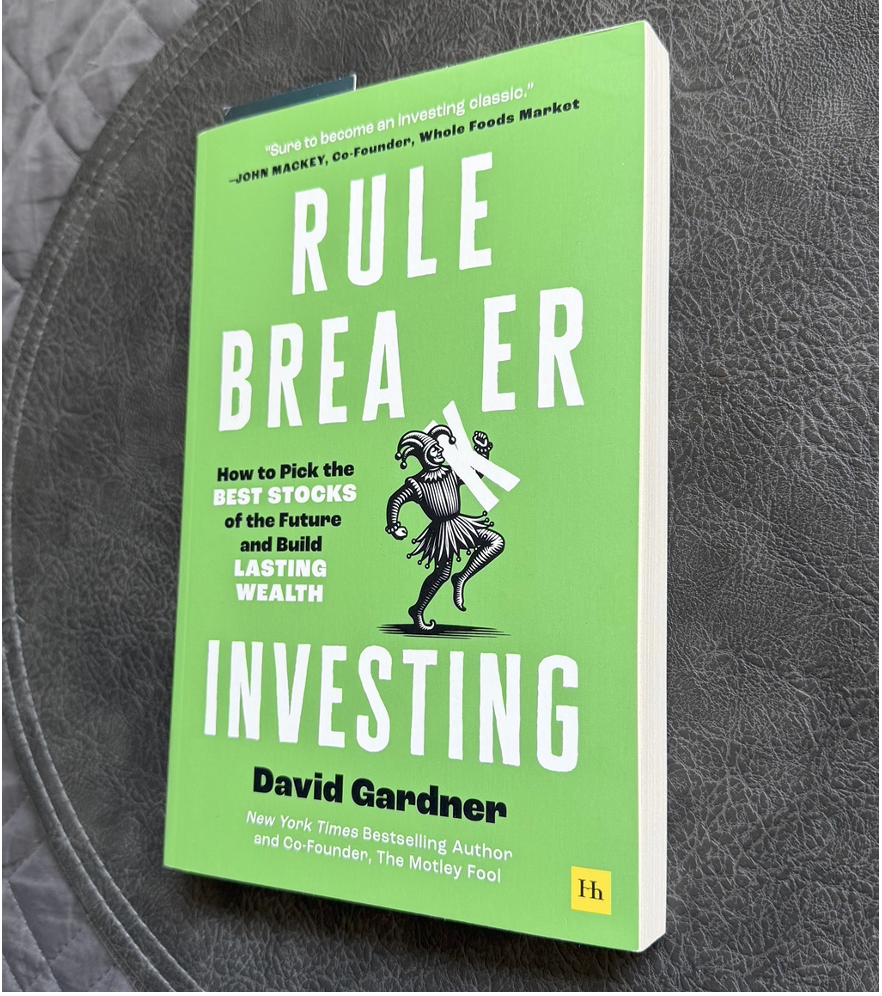
Though he still hosts a regular podcast, David Gardner retired from his day-to-day stock-picking duties at the Fool in May 2021. Last year, he published what he considered his final stock market book, Rule Breaker Investing. I picked up a copy earlier this year and found it an easy read. It mostly rehashes the principles he’s been preaching for over 20 years, and even though I was familiar with them, it was great to go over them one more time.
Beyond the Stock Advisor, David also led another monthly newsletter called Motley Fool Rule Breakers. This was entirely his brainchild, where he targeted highly volatile first movers in emerging, disruptive industries. It was his expression of a venture-capital mindset as applied to public markets.
David and Tom have notably different investing styles. While Tom leans more toward value and financial metrics, David is pure growth, momentum-driven “Rule Breaking” investor. In my own investing, I find myself leaning toward David’s style, to an extent. Over the years, I’ve admired David’s uncanny ability to spot disruptive, fast-growing innovators—like Amazon, Nvidia, and Mercado Libre—early on. I also follow his approach of holding onto those winners for decades, through thick and thin.
David cast a massive net to find promising businesses, making over 200 recommendations in Stock Advisor and nearly 400 in Rule Breakers. My investing approach is much more concentrated: I prefer to pick a select few strong businesses (usually 20 to 30 at a time) that are good for the long-term, and I add to them opportunistically over time.
Another investor from the Motley Fool’s universe whose investing skills I admire is Jeff Fischer (no relation to Ken Fisher of Fisher Investments). I was introduced to him through a service called Motley Fool Pro, which launched in October 2008 right in the midst of the Great Financial Crisis. Jeff Fischer was its lead manager. It operated as a $1 million real-money, all-weather portfolio. It maintained a balance of about 70% high-quality, long-term individual stocks and 30% hedging and income strategies using stock options.
I subscribed to Pro in 2008 and stayed with it for five years. Those five years turned out to be an excellent learning opportunity for me, as I learned the ropes on how to use stock options. Jeff Fischer made a prescient buy call on Facebook in September 2012, barely months after its IPO. He recommended that we buy CALLs on Facebook, which I promptly did and later converted into shares. I still have his buy rec email from September 18, 2012 in my archives:

I tend to be wary of buying IPO stocks, but fortunately, I did back then. Facebook (now Meta) remains a significant allocation in my portfolio to this day. Just like the Gardner brothers, Jeff Fischer was an excellent teacher and a good writer, and I thoroughly enjoyed reading his frequent thoughts during those volatile post-GFC years. If there is one thing I have always admired about The Motley Fool, it’s that they consistently had excellent writers and editors.
As the years have gone by since I started following the Fool’s letters, I have developed my own investing style—one that is much more suited to my personal temperament and investing goals. I still subscribe to their flagship service, but I use it more to generate ideas for further due diligence rather than following their picks verbatim. With David Gardner stepping down, I do feel the service has lost some of its sparkle.
The Motley Fool does have a tendency to hype up emerging trends that sometimes turn out to be duds—think 3D printing in 2012, cannabis stocks in 2018, or the stay-at-home trend in 2020. I feel that their overly enthusiastic approach to unproven trends misleads novice investors, and when things go awry, it can possibly turn them off from future investing entirely.
However, I really don’t have much to complain about. I can say unequivocally that I have gotten far more good from The Motley Fool service since I began this journey in the early 2000s. Kudos to them!
David, in his new book, writes about his investing mantra “Buy High, and Try Not to Sell”. His approach makes an interesting contrast with Pulak Prasad’s investing style that I wrote about in October. I will write more about their differing approaches in another blog post.
Hi Emcee,
I hope you are doing well. I’m a long time follower of your posts and appreciate your efforts, over the years, to educate regular folks like me.
The ytd performance along with geopolitical happenings has caused me to think about you and your decision making process with regard to deploying some of your dry powder reserves.
I would find your take interesting, should you wish to share.
In any case, be well!!
Best,
Joel
Hi Joel:
Thanks for reaching out. Indeed the US stock market is down by about 10% today. S&P 500 has not yet breached 10% mark so I haven’t deployed any dry powder cash yet. As you might be aware, I start buying stocks when the market is off 10% from its peak, and continue buying as/if it goes down further, stopping only when it stops declining (or if I run out of dry powder which shouldn’t happen unless we are staring at 50% down market). Last time I had a dry powder buy opportunity was in March 2025 when S&P fell by about 20%. Before that, in 2022, the market went down by ~25%. In 2020, it fell by ~35%. As you can see, this happens with reasonable regularity that I don’t get surprised by it.
Here are two relevant posts on this topic worth perusing again …
https://www.investingparexc.com/2018/01/07/use-cash-dry-powder/
https://www.investingparexc.com/2022/03/15/ready-for-a-50-drop/
I will post a note on my blog site when I start bargain buying.
Happy investing!